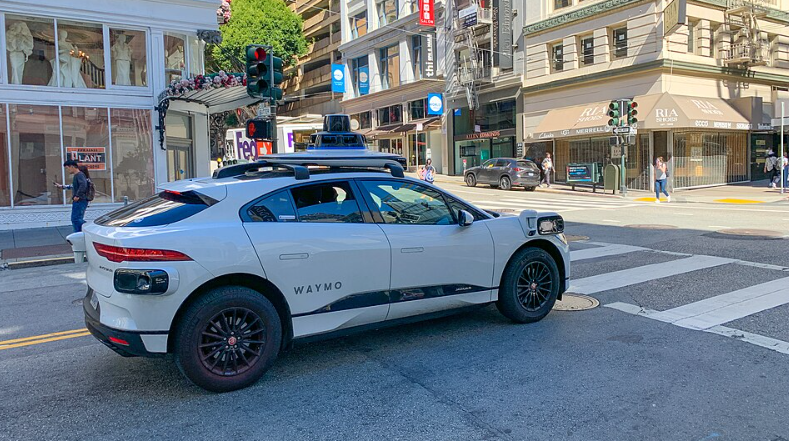
Waymo cars first gained popularity in big cities, but are now being easily found in suburban areas like Redwood City.
Waymo self-driving cars began developing in 2009 under Google in Mountain View, California. In 2016, Waymo became independent under Alphabet Inc. In 2018, after multiple test runs and experiments, Phoenix became the first state to feature its cars. Finally, Waymo was introduced to Redwood City and other peninsulas in Nov. 2025. Freshman Sasha Alpert shared how she has been noticing these cars in her community.
“I definitely used to see more [Waymo cars] in the city,” Alpert said. “But now I’ve been seeing them more locally and closer to me and the school.”
These cars have quickly become a controversial topic. According to Understanding AI, Waymo has been involved in over 40 incidents, including the deaths of pets and people, serious injuries and destruction of vehicles. However, according to Waymo, their cars have 91% fewer serious injury-inducing crashes and 92% fewer pedestrian crashes than the average taxi. This data has gotten the attention of students who have their own opinions about Waymo cars.
“[The cars] seem to be working fine,” freshman Sophia Achterkirchen said. “But I feel like they are kind of dangerous, because I heard that one time an ambulance was coming and it didn’t move over.”
Alpert believes that the Waymo cars are helpful.
“I think they’re pretty interesting,” Alpert said. “They’re actually kind of fun. I’ve been in one before, and it was a really smooth ride.”
With many kinds of perspectives on Waymo cars, more questions are being raised. The most prominent opinions are centered around the safety and efficiency of these cars. Some students shared their views on the safety of Waymo cars.
“I think these cars are somewhat safe,” freshman Rylan Walter said. “I think the cars could do better than humans every once in a while, but I think they can also do worse.”
Alpert made a comment about passengers interfering with the cars’ driving mechanisms.
“I believe these cars are safe because there are sensors all around the car,” Alpert said. “But I also feel like if something happened, it would be from one of the people riding in the car, maybe by touching the steering wheel or the pedals.”
With the growth of technology and artificial intelligence (AI) in our world, there have been many advancements in transportation, including Waymo cars. Now that self-driving cars have become a reality, the next question is what the future holds for these cars. Waymo’s engineering and operations teams will continue to improve it with passenger feedback, but it is also important to consider what people think about the future of these cars.
“I think Waymo will become more popular,” freshman Raelyn Fuh said. “But some people will also doubt their abilities, like getting someone safely to their destination, so there will definitely be some controversy over Waymo cars.”
Alpert discusses her ideas about the future of these cars and how they might become personal vehicles, as well as become a bigger part of people’s lives overall.
“I feel like they will definitely turn into more efficient techy cars,” Alpert said. “I also feel like they’re gonna take over, kind of like Tesla’s did, like how everybody owns them now. And I feel like Waymos might eventually get to the point where they’re being sold.”
Achterkirchen made a final statement about Waymo cars overall.
“I think they are safe and efficient,” Achterkirchen said. “But they can use some work. If they can make the cars safer, then I think they would have a good impact [on our community]. But for now, I feel like they aren’t too safe.”