Starting in the 2027-28 school year, all public high schools in California will be required to offer a stand-alone one-semester personal finance class. At Woodside, guidance on this change is still coming slowly, with the exact implementation of this new class still unclear, though it seems likely that personal finance will replace the current one-semester course, Economics, creating a new Government/Personal Finance class.
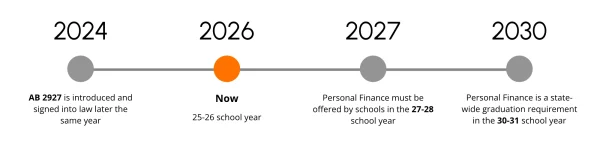
The law, AB 2927, introduced in 2024 and signed later that year, makes personal finance a graduation requirement for all California public and charter high schools starting in the 2030-31 school year. On March 18, 2026, Governor Gavin Newsom announced that California had moved forward with implementing personal finance with a curriculum guide adopted by the State Board of Education. The guide includes topics such as budgeting, managing credit, investing and saving.
“I feel like [this class] could really help a lot of people, especially, [for example, some] immigrants who don’t learn that,” junior Jaylah Goins said. “[Right now], you’re not learning that from school, [but] you need to learn it somewhere. And if your parents don’t know how to, or if you don’t know how to, then how are you ever gonna learn?”
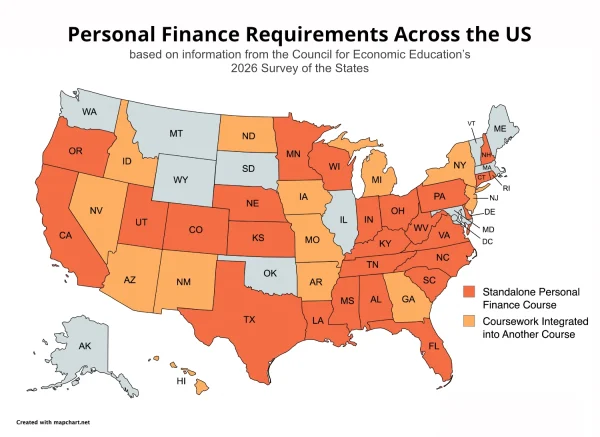
As of 2026, 39 states require some form of personal finance as a graduation requirement, according to the Council for Economic Education’s 2026 Survey of the States. New York Times columnist Ann Carrns states that the rise in these requirements is partially because of the COVID-19 pandemic putting a spotlight on household finances and income inequality, as well as growing concern about financial disparities between ethnic and racial groups.
AB 2927 allows any teacher with a credential in social science, business, math or home economics to teach the course. The law allows personal finance to replace the current graduation requirement of economics.
“I think [personal finance] would, just realistically and feasibly, have to still live under the social science umbrella,” Instructional Vice Principal Adrienne Philippe said.
According to Philippe, the most realistic avenue for Woodside to implement this new requirement would be to replace the one semester of economics in the current Government/Economics class with personal finance instead, creating a Government/Personal Finance class. Social science teacher and department chair Ramie Macioce agreed. Macioce said that the social sciences department is excited about this change, and that she’s not worried about economics no longer being a graduation requirement.
“I don’t really see any negatives,” Macioce said. “The benefits [of students taking personal finance] would outweigh the costs of the kids not taking economics.”
Macioce said she thinks economics would still be offered as an elective of some form. Still, the implementation of personal finance is not set in stone. Philippe said it’s on the school’s radar, but it’s “still kind of on the back burner,” and they’ll use the long on-ramp until it’s required to their advantage. According to Philippe, there still needs to be conversations with the math and social sciences team to determine how to best implement the requirement. At the district, work has not yet started on the personal finance requirement either.
“The district is continuing to monitor and incorporate state-issued guidance and resources, so that we fully comply with state requirements before we begin work,” Elizabeth Chacón Ed.D., Assistant Superintendent of Educational Services at the district, said.
Some faculty in the social sciences department are eager to begin work, but feel that guidance on implementation has been slow to arrive from the district. Chacón responded to this sentiment.
“The district recognizes and appreciates the importance of timely communication,” Chacón said. “At the same time, we are proceeding carefully to make sure that guidance is accurate, aligned with state expectations, and supports successful implementation. The district remains committed to providing clear direction as soon as it is available and to supporting educators throughout the process.”
Chacón said that the district anticipates that more guidance will be provided in the upcoming school year, as they get more information from the state.
“I think [waiting for now] is a pretty good approach,” Goins said. “But I feel like [offering the class] sooner is better than [offering it] later, because there are seniors that aren’t going to be able to experience [this class] who probably need it a lot,” Goins said.
Goins also had concerns about the class only being one semester. She said that one semester might not be long enough for all students to understand the material.
“It kinda takes me a while to understand the subject [in a class],” Goins said. “So I feel like [if personal finance was] one semester, I would only remember some parts of it.”
Goins is a junior, meaning she will graduate around June 2027, the last school year before personal finance is a required offering. Goins was disappointed that she won’t be able to take the class.
“I think they should add [personal finance] next year so I can take the class,” Goins said.