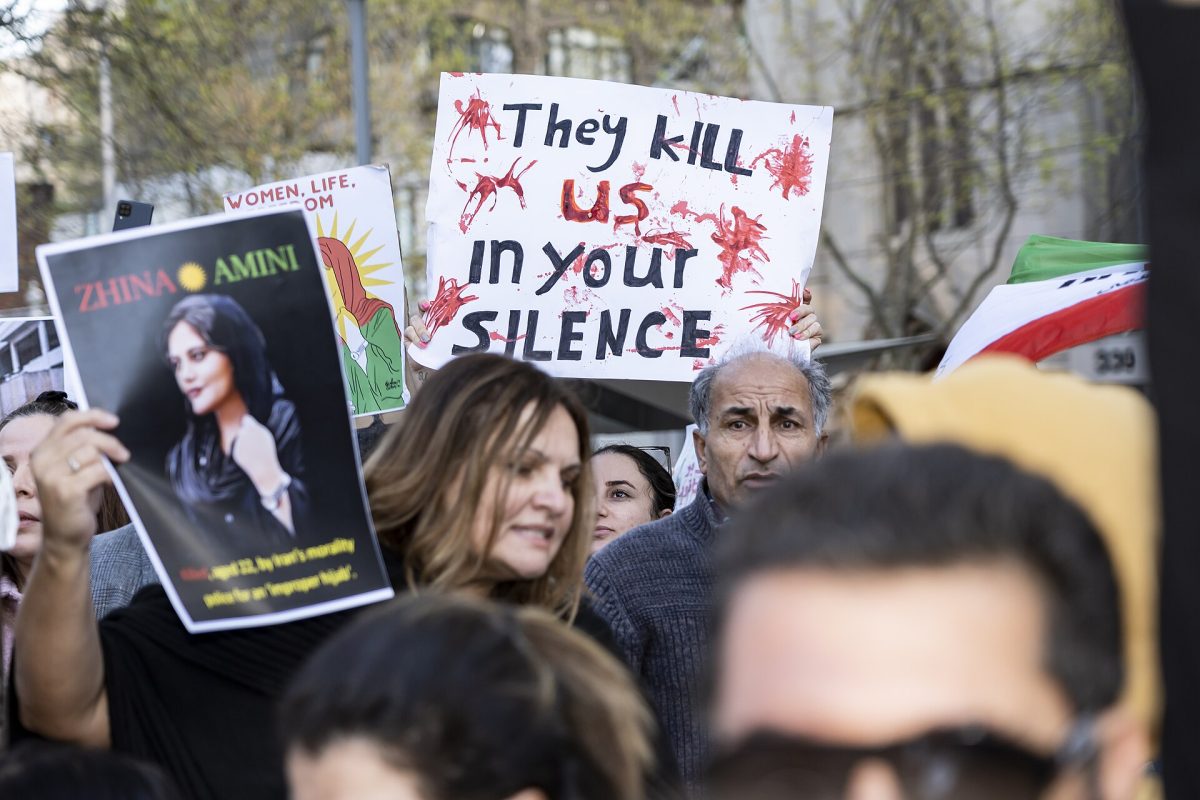
The low hum of sirens is overshadowed by the ringing of rubber bullets in the streets of Tehran. Moments ago, shopkeepers walked out. Office buildings lay empty. Jan. 3, 2026, marked the day Iran set itself ablaze in the bloodiest protests since the 1979 revolution.
What followed was not a brief uprising but a sustained national crisis. Throughout January, Iran was engulfed in demonstrations that were met with overwhelming force. According to The Associated Press, more than 2,500 people were killed by Iranian government forces during the crackdown. The scale of the violence reignited a familiar question both inside and outside the country: Is this finally the moment Iran changes?
The answer, based on history, is no. Pilla Zargar, an advanced-standing (AS) English II and English IV teacher, is an Iranian American who lost her nanny and many of her possessions when she came to America in 1980. Thus, she wants Iran to be free of dictatorship.
“I look at these mullahs and the government of Iran in the same way as a video game my kids play,” Zargar said. “At the end of each level, there’s this big monster, and you have to sit there and kind of slowly attack this monster, and it gets a little bit weaker each time.”
This metaphor reflects the reality of protest movements in Iran. They are persistent and courageous, yet rarely decisive. That slow erosion does not amount to collapse.
“Do I think that this is going to be it?” Zargar said. “Unfortunately, no. Do I think that they’re getting a little bit weaker each time? Yes.”
The Islamic Republic has survived for decades because it understands how to absorb unrest without surrendering power. Protest is met with violence, violence with silence and silence with time. For example, in the 1990s, students protested for changes and reforms. These protests were met with the secret police going dorm to dorm, beating and terrorizing people. Later on, economic struggles caused by the second American invasion of Iraq led to more protests being brutally put down in 2007. Still, the January demonstrations stood out for their scope. Unlike earlier movements dominated by students or urban youth, this uprising crossed social and economic boundaries.
“The most promising thing about this last set of protests was that there were just so many people out there… the people who run the bazaars were out, the rich people were out, the poor people were out, men and women and children,” Zargar said.
Such unity poses a real threat to authoritarian systems that rely on division to survive.
Yet even this level of participation failed to produce structural change. One reason lies in the regime’s design. Iran’s political system is not built to reform under pressure but to reproduce itself. Leadership changes have historically reinforced power rather than weakened it. When Khomeini, the original revolutionary leader of Iran, died in 1989, he was replaced by the current leader, Ayatollah Khamenei. Instead of the regime weakening, its strength grew.
“I always thought that when [Khomeini] died, that would be it,” Zargar said. “And then this guy, Khamenei, was there to pick up the reins right afterwards. Unfortunately, it’s pretty brutal.”
The transition demonstrated that individuals matter less than the system that sustains them. Usually, regimes are held together by kingpins, megalomaniacs holding oppressive governments together: Gaddafi, Castro and Hussein are all prime examples of this. Meanwhile, international attention has intensified. Protests in Iran have drawn solidarity demonstrations and widespread engagement abroad, particularly in the United States.
“I find it really lovely, how much Americans are invested in it… It’s nice to see that people are paying attention… and that people are staying active and aware,” Zargar said.
Awareness can amplify voices and document abuses, but it does not dismantle institutions rooted in ideology, surveillance and force.
This gap between resistance and results explains why Iran has not changed despite repeated uprisings. Each wave of protest weakens the regime’s legitimacy, but legitimacy alone does not hold power. The Islamic Republic maintains control through security forces, information control and a political structure designed to outlast dissent.
Iran’s unrest reveals a grim reality. The regime weakens incrementally but does not fall. Like the monster at the end of the level, it absorbs damage, retreats and returns intact. Protest becomes cyclical rather than revolutionary. People will keep rising, and the streets of Tehran will keep burning. But without structural change, hope will again be met with repression, and the world will once more ask a question history has already answered.