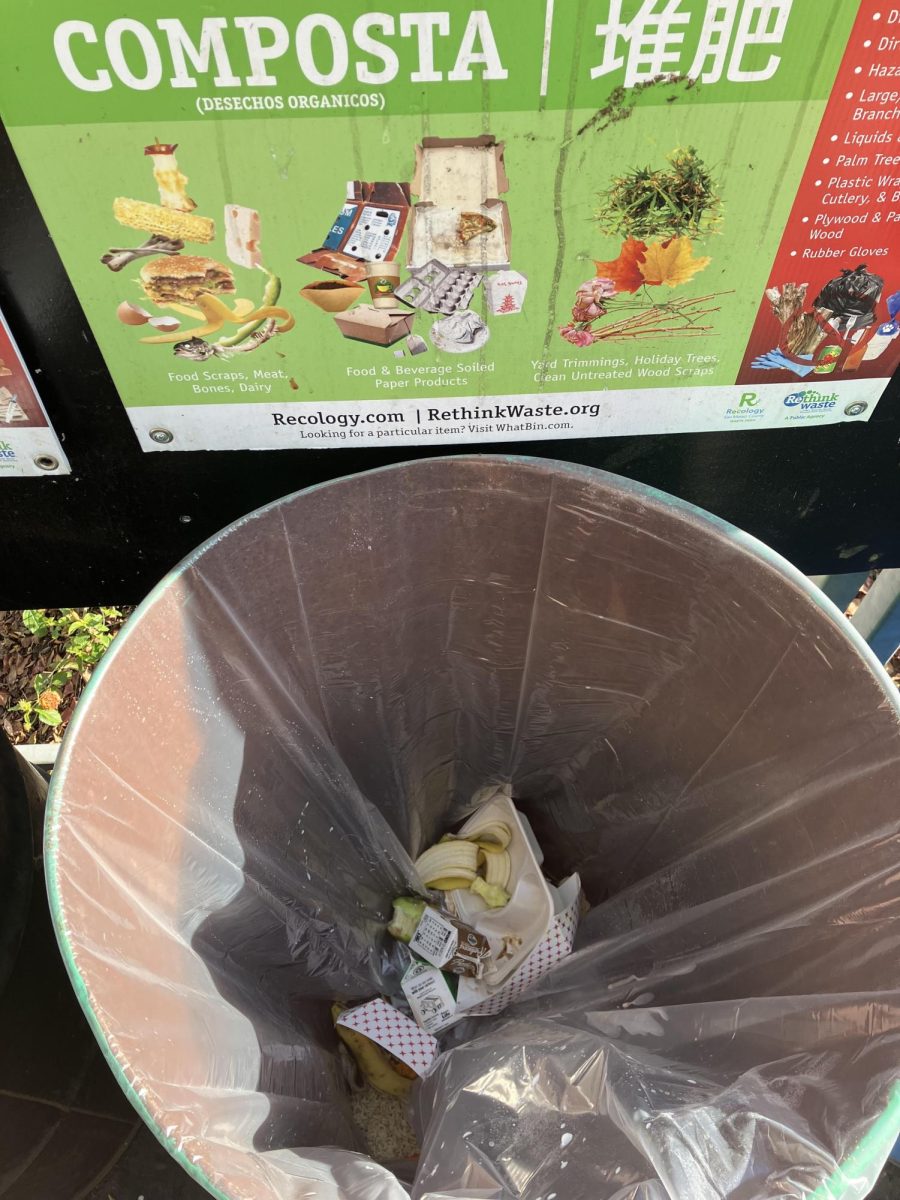
Food waste in the US accounts for 2% of greenhouse gas emissions and occupies 25% of all landfill space. Approximately $500 billion is lost in food waste annually in the US, and the structure of schools often makes them vulnerable to producing large amounts of food waste.
In the US, around 89 million tons of food go to waste every year. This is around $1,000 per person of waste, adding up to 2% of the US’s GDP. Woodside is part of the California Universal Meals Program, a statewide program that offers free school meals, and so the school is required to provide for any and all students who receive meals through the school. There are many potential challenges that the food system can face in schools that could lead to food waste or insufficient food to provide for students.
“Our biggest issues would be manufacturing supply shortage and fluctuating student participation, which can make forecasting difficult,” District Food Service Supervisor Julie Jones said. “[Some] strong points [of the district’s food supply system] would be building relationships with vendors, comparing pricing, and continuing to shop for the best pricing as prices continue to rise. We’re constantly looking for ways to optimize ordering, reduce waste, and improve delivery scheduling.”
Throwing away food is one of the many sources of food waste in the country, but there are other ways food can be wasted. According to Green Academy teacher Ann Akey, the amount of food waste produced in the US has larger consequences.
“I think it’s pretty amazing that 40% of our food in this country is thrown out,” Akey said. “I don’t think most people realize that [it’s] tied into climate goals, greenhouse gas emissions or impacted water. All of the challenges that we associate with agriculture are just amplified that much more because we’re producing all this food that we don’t, in fact, eat.”
The variability of student participation is one of the challenges that the school and the cafeteria have to address.
“We’ve been hit with days where we’ve had really light attendance and the [cafeteria staff] weren’t expecting it,” Administrative Vice Principal Chuck Velschow said. “Then they’re stuck with all this food that’s perishable, and they have to either throw it away or give it away.”
According to Akey, food waste breaks down in landfills in one of two ways — either anaerobically or aerobically, with or without oxygen, producing methane or carbon dioxide. When food breaks down in landfills, it produces methane, a more potent greenhouse gas than carbon dioxide, which accelerates global warming. Velschow said that it’s difficult to get people to take the time to sort out their waste, but that it’s important to do so.
“Please, please, try to compost, recycle and minimize what we’re putting in the landfill,” Velschow said. “We do this speech with the ninth graders and talk about keeping the campus litter-free, but it’s also about that you guys are the ones who are going to inherit the earth, [as well as] your kids and grandkids, [so] we want it to be a good place for you guys.”
According to Jones, food waste from the food supply system, especially at schools, is a complicated problem without an easy solution.
“The school food supply chain is more complex than most people realize,” Jones said. “Our team works hard to put together a compliant, healthy meal for our students every day despite a tight budget and fluctuating student participation. By monitoring inventory, communicating, and planning ahead, we’re able to maintain consistent service across all schools while minimizing waste and ensuring every student has access to nutritious and balanced meals so they can focus on learning.”
According to Akey, it’s crucial for people to control what they can and make an effort in order to combat climate change at their own level.
“There are a lot of decisions made for you that were made by your parents or [because of] other factors,” Akey said. “But this [decision], how we choose to dispose of our waste, is a personal decision, so I would encourage people to participate.”