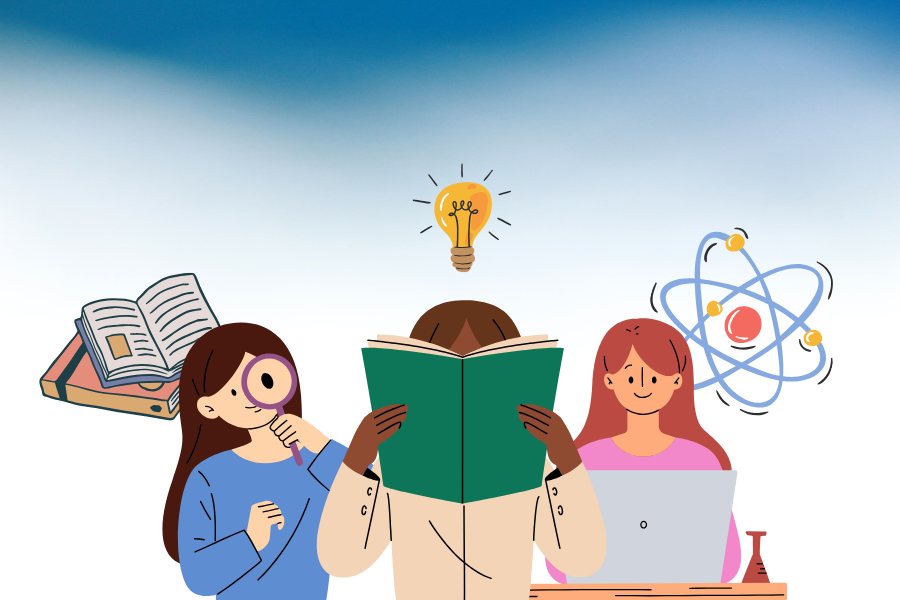
Universal design for learning (UDL) is a teaching framework that aims to create a more accessible learning environment for all students. This is done by giving students multiple options or ways to access and learn the same information.
In a more traditional classroom, a teacher might teach a topic in one way, such as with a presentation or a note-taking assignment. Then, they might have students present their learning in one way, like with a multiple-choice test or essay. Using the UDL framework, a teacher would provide students with multiple ways to learn and present their learning. Allison Gamlen is a visual and performing arts coordinator at the San Mateo Office of Education and a few months ago presented a professional development session at Woodside about UDL.
“Traditional teaching is often one-size-fits-all,” Gamlen said. “The teacher delivers the content in a single format, and students are expected to learn and show mastery in that format. UDL flips that. It recognizes that there is no ‘average’ learner, so why should we teach as if there is?”
English teacher Lisa Camera said that the traditional teaching system was set up to serve the biggest number of students with the fewest resources, which can create this sort of one-size-fits-all approach.
“A lot of teachers go into teaching because they were good students,” Camera said. “That’s the kind of student that thrives. The [student] who can sit quietly and patiently and just kind of soak in all the information like a sponge. But a lot of our students don’t learn that way. So we [as teachers] have to mix it up. [If we] want to be a good teacher to all kids, you have to be able to do that.”
Teachers could incorporate the UDL framework by posting the slides of a lesson on Canvas, or providing an audiobook on a reading assignment. They could also give students a choice on how they show their learning, maybe by offering the option of making a poster or creative project in addition to the more typical quiz or essay.
“It’s almost like thinking of it as a menu of options,” district special education instructional coach and former Woodside special education teacher Jayanthi Mehta said.
The UDL guidelines break down UDL into three main categories: multiple means of engagement, multiple means of representation and multiple means of expression. After getting a brief explanation on the concept of UDL, Camera said she thought the idea was cool, but it could be hard for teachers to implement.
“I mean the problem with the educational system in America is that it is not designed for individual learning,” Camera said. “I have 30 students in my third period class, and when you’re teaching 30 students with the standards that we’re expected to teach, it’s really hard to individualize instruction like that.”
Rather than individualizing instruction, Gamlen said that UDL is more about letting students choose how they learn and express themselves.
“It’s not about creating separate lessons for every student—it’s about designing instruction that offers options upfront so students can engage in ways that work for them,” Gamlen said.
Mehta said UDL also includes students who might have different needs on different days.
“[You might] not want the same thing every day,” Mehta said. “[One day] you might walk in saying, ‘You know what, I overslept, I’m really tired, I need a lot of support to do this assignment.’ Another day you might walk in and say, ‘Oh my gosh, I’m so well rested, bring it on, I don’t need support, I can do whatever the task is for today.’”
Gamlen said that one problem UDL adoption faces is resistance to change because of teacher bias.
“Sometimes, I hear teachers say things like, ‘Students need to figure out how to live in the real world; we can’t coddle them,’ or ‘I’m low-tech; I don’t need to add more things to my teaching,’” Gamlen said. “But the real world has UDL happening all over. For example, think of all the things a driver can adjust in their car [such as] the seat, the mirrors [and] the steering wheel height. Or a sidewalk ramp at a crosswalk, [which] can help someone in a wheelchair, someone with a cane [or] someone pushing a cart or stroller. The real world has adaptations that benefit everyone, our classrooms can do the same.”
But Gamlen said that the biggest challenges in implementing UDL are time and systemic barriers.
“Teachers are already stretched thin, and if they don’t get training and planning time, UDL can feel overwhelming,” Gamlen said.
Stephanie Finander, who teaches AP science and math classes, said that since her job is to prepare students for the AP assessment, she sort of feels constrained to teaching them to express themselves in the way the test requires.
“I have in the past had an option of a multiple choice test, or a very free and open free response test…or choose from these questions…but I feel like since the AP [test] is looking for something specific, we need to test that specific thing,” Finander said.
Anneke Vera is an education specialist at Woodside who recently spoke about UDL during a professional development day.
“I get why some teachers hesitate [with UDL],” Vera said. “Time, training and resources are real challenges. But starting small, like offering assignment choices or adding visuals, can make a big impact without extra stress.”
A common assumption about UDL is that it could lower standards or rigor, but Mehta said that UDL principles don’t lower standards since students still have to demonstrate their understanding at the same level, even if it’s in a different way.
“Common misconceptions about UDL include thinking it’s just for students with disabilities, requires separate lessons or lowers standards,” Vera said. “In reality, UDL raises expectations by giving all students different ways to succeed—without adding extra work or expensive tech.”
Mehta said that when teachers first hear about UDL, it sounds like a lot of work, but once it’s broken down, many teachers realize they are actually already incorporating aspects of UDL into their teaching. Teachers like Camera and Finander already try to give students multiple ways to interact with the content. Finander said she does this because everyone has a different learning style.
“Different students interact with the material in different ways,” Finander said. “And [for] some of them, the best thing for them is to write down what I’m saying. [For others], the best thing for them is to instead look at what I’m drawing and listen to what I’m saying, and not write down anything.”
Finander, like many other teachers, already incorporates principles of UDL without even knowing, like how she already uploads her presentation slides onto Canvas for students to reference.
“UDL isn’t about throwing out everything you’ve been doing and starting over,” Gamlen said. “It’s about small shifts that make learning more accessible.”